

Artist Talks at IUS: A Conversation with Nino Lojpur
Dear Nino, thank you for taking the time to share your thoughts about your exhibition, The Bond Between Man and Nature.
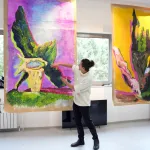
Your paintings are inspired by Mount Treskavica, but they offer much more than representations of a familiar landscape. Through expressive colors, monumental forms, and abstraction, you explore the relationship between nature, memory, and personal experience. What particularly interests me is how a physical landscape becomes something deeply personal, while remaining open to the viewer's interpretation.
I'd like to begin with your connection to Treskavica and then explore how that relationship finds its way into your paintings.
1. Treskavica and Personal Experience
Treskavica is the central subject of all nine paintings. What is your personal connection to this mountain, and what inspired you to dedicate an entire exhibition to it?
Treskavica certainly holds a very special place in my life. Ever since I was a child, my mother would take me and my sister hiking around Sarajevo. Treskavica became our hotspot when my father started camping on the lakeside, and we would help him carry his food and tools. Every time I would go, it would be a new chapter of my relationship with the mountain. I was able to reconnect with myself on such a deep level that I had to create art to really explain the significance it held. It is my place of letting go and freeing myself of the shackles of urban life. It is also a great source of inspiration as you could imagine.
2. The Inner Landscape
In your artist statement, you describe the exhibition as a projection of an “inner landscape.” How do memories and emotions transform the physical landscape into the images we see in your paintings? Do you paint what you remember seeing, or what you remember feeling?
At the time of creating the paintings, I was interested in understanding indigenous cultures who talked about the spirit of nature, nature being a sentient being, etc. How do you portray such a concept? Being deeply inspired by Yugoslav monuments, I had the idea to create monuments out of the varied landscapes I saw on Treskavica. Each painting is connected to a particular place, and shapes started revealing themselves as I was doing the sketches. My main focus was creating rich, colorful compositions that reflect the feeling of being alive, and being a part of something forever grand and beautiful.
3. The Human Presence
The exhibition explores the bond between human beings and nature, yet there are no clearly recognizable human figures in the paintings. Was this intentional? Where do you locate the human presence in these works?
My first set of paintings were more literal portrayals of natural landscapes. They were images of memories as we have come to imagine them in our modern society. You could recognize hills, lakes, people and animals. What I realized during that process is that I was just scraping the surface. To really explore a personal connection, an artist can use abstraction to point to something that is beyond what is observed through the eyes. My paintings are more a dream-like state of Treskavica - you somehow know you are in your dream, and yet you cannot see yourself. I am still present, but implicitly.
4. Form and Imagination
Some of your mountain formations almost resemble human bodies, animals, or other living creatures. Is this ambiguity intentional, or do these shapes emerge naturally during the creative process?
We are only human, and in our human condition, we are programmed to see these resemblances. I have so many fond memories of sitting in front of rock formations and seeing faces, bodies, animals, etc. I would look at the sky and see these figures. I am glad I was able to achieve a similar feeling nature seems to achieve all the time.
5. Color and Emotional Expression
Your use of color is particularly striking. The intense purples, reds, yellows, and blues move far beyond a realistic representation of nature. How do you choose your colors, and what role do they play in expressing your experience of the landscape?
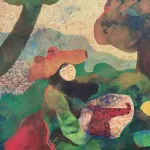
This question brings back memories of me trying to find all of these colors in Sarajevo (haha). I bought so many different bottles of acrylic paint in order to achieve the desired result. Some of those colors you cannot mix from the standard set, so it was quite a challenge. They truly carry the whole body of work, as they were one of the tools I used to portray my emotions connected to Treskavica. Each painting carries a certain personal burden, and I keep thinking of the one that has bright reds in it. There were so many times when I felt like I was walking alone in a desert, mostly because I was quite mad at the world around me. Of course, Treskavica is far from a desolate wasteland, and yet my own state played tricks on me, and that is what I would see wherever I would look. Thankfully, the greens managed to calm me down time and time again.
6. Materials and Artistic Process
You chose to work with acrylic paint on large sheets of natron paper rather than traditional canvas. What led you to this choice, and how does the material influence your work?
Your paintings were also conceived to hang freely in the exhibition space. How does this affect the way visitors experience them?
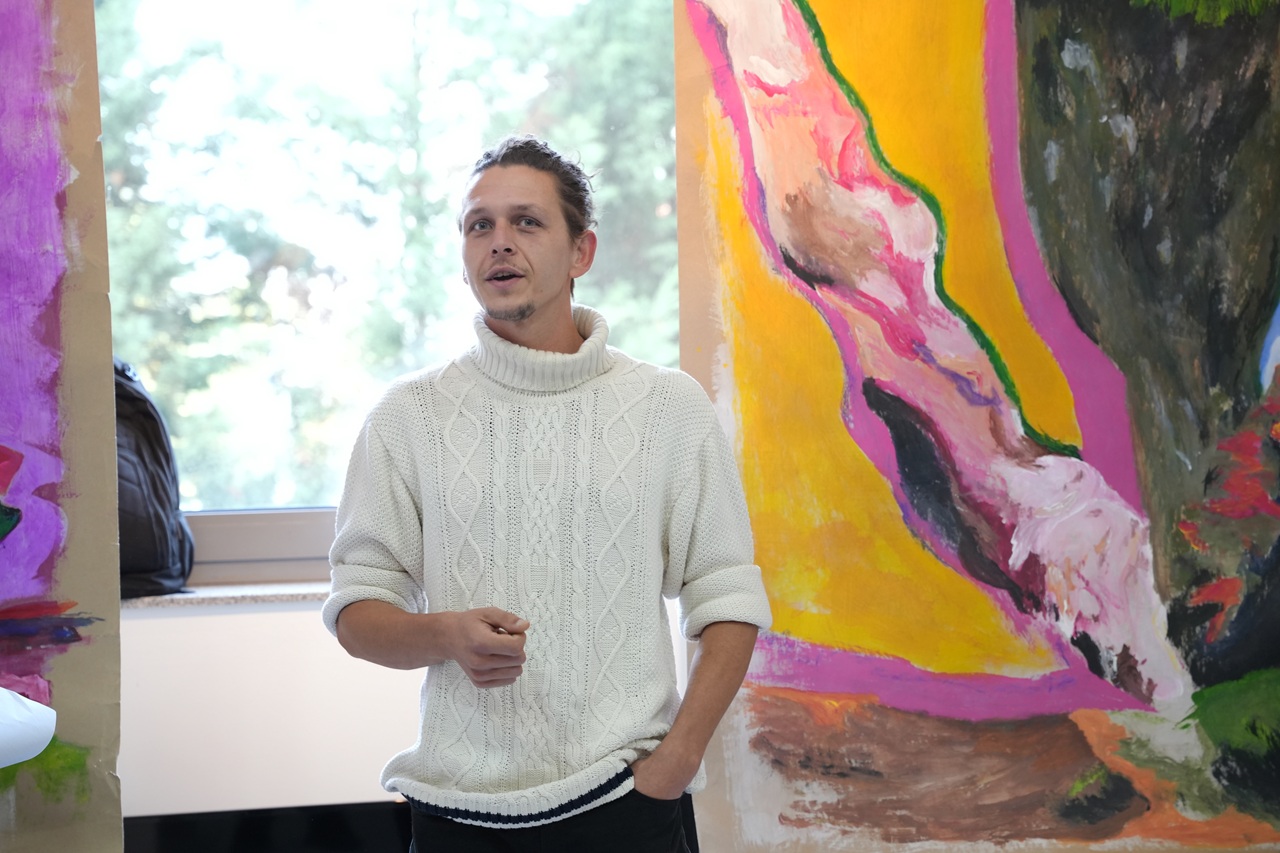
I remember just starting my studies when a professor was quite concerned, I was painting on paper. Mind you, I came to the Academy of Fine Arts without an education in traditional painting, so I was able to experiment to a great extent since I didn't have to follow the set rules. Paper turned out to be quite a convenient medium, as I could just roll up the paintings and carry a great amount of information in one arm. I can fill an entire room with shapes and colors quite easily. I decided on natron paper because of its tone, as it evoked a feeling of time and decay. As a bonus, it comes in a roll, so you can freely choose the length of the cut paper. On one of the paintings, you can see a seam because I had to make the format larger, which is another convenient property. Paper is lightweight, so it can be hung in space, and the observer can walk around the paintings. This is quite similar to how I imagine remembering - there is a space that enables you to fly around and see past experiences through different perspectives.
7. Artistic Development
You completed your undergraduate studies at IUS before pursuing your master’s degree at the Academy of Fine Arts in Sarajevo. Looking back, how has your artistic approach evolved, and what advice would you give to students who are still developing their own artistic voice?
The journey is more important than the destination. I mentioned time and decay, and these are the constants that we experience in this world. Instead of being afraid, it is wiser to accept the truth and continue growing and expanding, especially if you feel like you have something to show. Get rid of the feeling of shame when showing. Be as expressive as you can at any given point in time. Don't be afraid of colors!
8. Interpretation and the Viewer
Your artist statement emphasizes leaving room for individual interpretation. How important is it to you that viewers discover meanings you may not have consciously intended? What would you like someone unfamiliar with Treskavica to take away from these paintings?
Everyone has their own interpretation, so it seems quite silly for me to believe that they wouldn't. We could be walking side by side on Treskavica, and it would be two completely different experiences. We live in a world where propaganda is ever-present, so it can be hard to accept that we can have freedom of thought. I invite the viewer to go to Treskavica if they haven’t and try to let go of the constraints of the mind in order to see what is beyond the surface of wilderness.
Thank you, Nino, for sharing your thoughts and giving us a closer look at your work.
Your exhibition offers an interesting opportunity to consider how nature becomes part of our personal experience, shaped by memory, emotion, and imagination. It also reminds us that the same landscape can mean something entirely different to each person who encounters it.
Thank you once again for sharing The Bond Between Man and Nature with the IUS Art Gallery.
Read more about the exhibition The Bond Between Man and Nature: From Treskavica to the Canvas: IUS Alumnus Nino Lojpur Exhibits at His Alma Mater